qualped author, create and design your future

A Declaration Twenty Sections

The Cut Line

The mountain I climb, the blueprint three authors handed me, the stage I built to carry the work, and the trail I leave for the people who cut their own.

Scroll

Before the climb

How to read this

Twenty sections follow, and a reader deserves the instructions before the climb starts.

This book runs on SPELJ, a genre I built by braiding three older ones. Short story supplies the scene, so an argument arrives with a body attached. Personal essay supplies my own stake, so nobody has to guess what I risk by putting this in public. Literary journalism supplies the hard ground: names, dates, page numbers, and sources a sceptic can check without my help.

Braided, the three do a job none of them does alone. A verified fact tells you what happened. A scene tells you how it landed on a body. A stake tells you why the person reporting it cares enough to spend a decade on it. Put all three in one paragraph and a reader can weigh the argument and the arguer at the same time.

Four things run through every substantial passage, and I keep all four in view while I draft. Scene: something happens somewhere. Self: I risk a judgment of my own. Substance: verified facts hold the page to earth. Significance: the scene and the evidence change how a reader sees a life, an institution, or a future.

Watch for the cards with the blue top rule. Those carry sources, and they sit inside the argument rather than in a footnote, because a claim you cannot check has no right to your afternoon. The full source list waits at the end, with links.

One warning before you start. This declaration hands over no method for getting rich and names no shortcut. It describes one route up one mountain, cut by one person across roughly two decades, with the falls reported at full size. Take whatever travels. Leave the rest on the ground.

Part One

The Ground

Where the trail stops, where the crowd turns, and what the fall costs a person who keeps climbing.

01

The Cut Line

A blade meets green and stops.

Behind the coastal strip where I grew up, Guyana holds a forest that shuts a trail inside one wet season. Cut a path in March. Walk it in August. The bush hands you back a wall. Anyone who wants a line through that country cuts it, and then cuts it again.

I carry that picture into every working morning in Ontario, and I want to state its status before I use it for two hundred paragraphs. I have not hacked a trail through the Pakaraima range with a cutlass in my fist. I grew up under the rain and the heat that close such trails, and the image took hold of me there. So read the mountain in these pages as a figure I chose on purpose. Read the desk, the books, the ledger, and the hours as the literal ground where the work happens.

Now the figure.

My life climbs a steep wilderness mountain, and no map marks the route, because I cut the route myself. The path demands clearing before it allows a step. I clear, I climb, I look toward a summit my boots have not yet touched. Gravity pulls the whole time. So does the flat comfortable ground below, where employers, markets, and feeds write a person’s day before that person wakes.

A path holds open only while someone keeps walking it. Footage Ron Lach, Pexels.

I claw upward. I find footing, wedge a boot into a crack, test the rock, and move. Sometimes the rock crumbles and I slip. A few times I have dropped a long way down the face and hung there, breathing. On rare occasions I have landed all the way back on the flat, at bare survival, counting what the fall left in the account and what it left in me.

Then I stand. I climb back to the last hold I trusted, and I resume from there rather than from zero. Each return costs months. Each return also hands me three things the first ascent could not: depth of vision, breadth of understanding, strength in wisdom. I keep going.

One question deserves an answer before the figure goes to work. Why a mountain, when the shelf already holds a ladder, a river, and a road?

A ladder hands a climber rungs that somebody else built and spaced for an average body. A river carries a passenger who chooses only how hard to paddle. A road runs wherever the engineers put it. Each of those pictures hides the labour I want to keep in view.

A mountain hides nothing. No rungs. No current. No survey crew ahead of you. Gravity argues against every metre, weather changes without consulting anybody, and the route belongs to whoever cut it. A mountain also allows for a fact the ladder denies. Other climbers work just as hard on other faces of the same rock, headed for peaks I will never see, and none of us stands above the others.

A trail through bush and a life share one hard property. Neither one holds itself open. Both close the moment the person who cut them stops cutting.

02

Two Ways Up

Every mountain offers two routes, and only one of them shows footprints.

The trail with footprints climbs too. I want to say that clearly, because a book of this kind can slide into contempt for ordinary people, and I refuse that slide. Millions of decent lives walk the marked route: school, credential, employer, mortgage, pension, grandchildren. Those lives raise children who read. They keep hospitals staffed and buses running. The marked trail carries real weight, and I owe it my thanks, because a marked trail fed me while I learned to cut.

The marked trail carries one flaw. It goes up somebody else’s mountain.

René Girard spent a career naming the mechanism behind that flaw. Girard (1923 to 2015) held the Andrew B. Hammond chair in French at Stanford from 1981. His book Deceit, Desire and the Novel reached French readers in 1961 and English readers in 1965. Its argument lands hard: a person rarely picks a desire alone. We copy. We watch a neighbour want a thing, and the wanting jumps the fence. Stanford summarised his claim in a single line at his death: our desires do not belong to us, and we want what others want.

Source note

Girard called the pattern mimetic desire, from the Greek word for imitation. He traced it through Cervantes, Stendhal, Proust, and Dostoevsky, then argued that copied desire breeds rivalry, because two people who want one object must fight for it.

René Girard, Deceit, Desire and the Novel (Johns Hopkins University Press, English edition 1965); Stanford Report obituary, 4 November 2015.

Hikers ascending a mountain ridge at sunrise
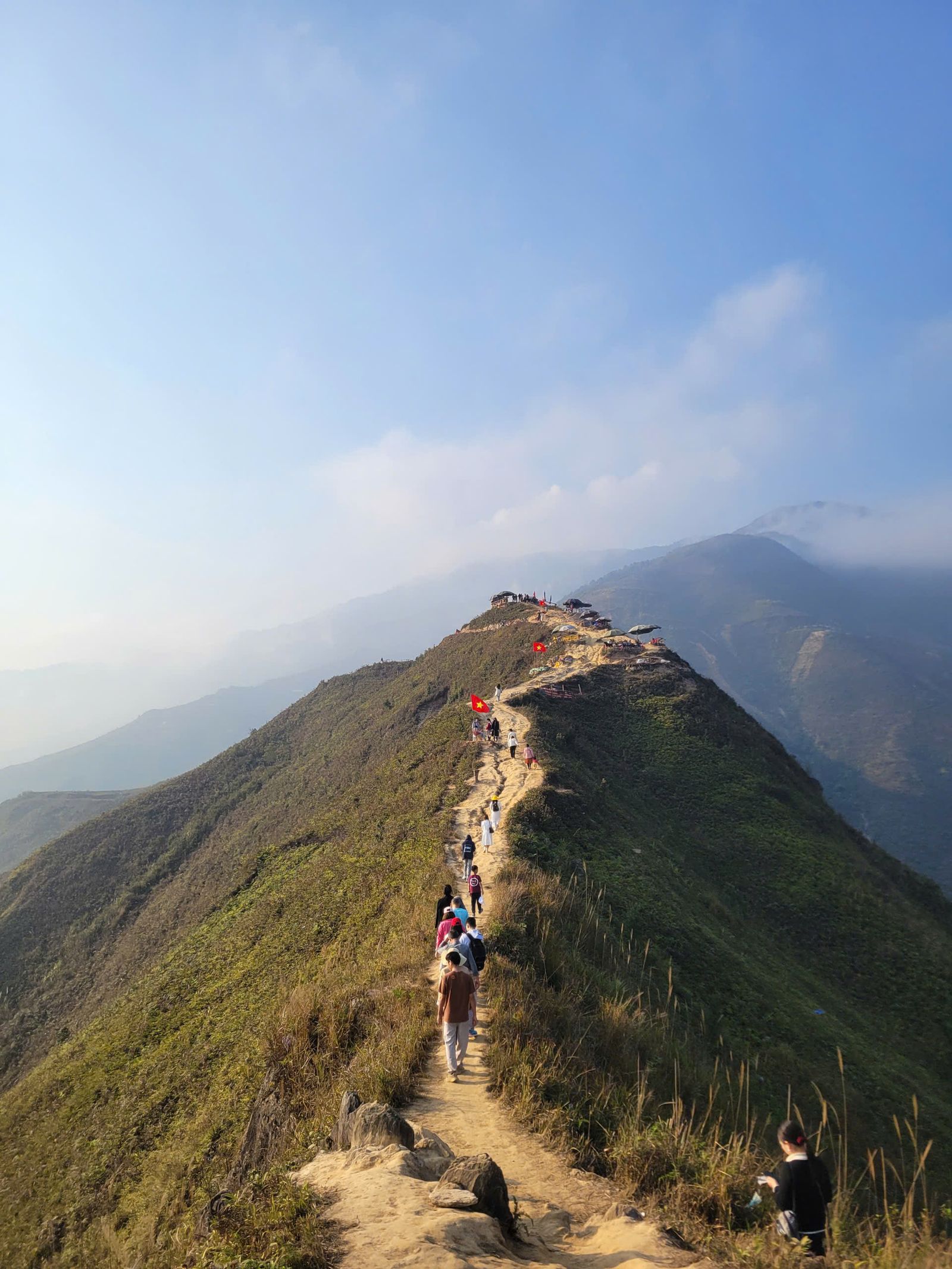
A line of climbers on a ridge already cut. The route asks nothing of them except endurance. Photograph Green odette, Pexels.

Girard gives me the sharpest question I know to ask about my own ambition. Take any goal I hold this morning and put one query to it: did I want this before I watched someone else want it? Most goals fail that test. A larger house, a louder title, a follower count, a prize with a dinner attached. Each one arrives secondhand, and each one drags me onto a slope where thousands already push.

Anybody can run that test, and it takes under an hour with a pen. List ten things you want, in plain words, with no dressing on them. Beside each line, write the name of the first person you watched want the same thing. Most lines fill in fast, and the speed supplies the verdict. A want that arrives with a face attached came from outside your own life. A want whose origin you cannot trace to any face has a fair claim on your hours.

Keep the discarded seven or eight on a second sheet rather than in the bin. A borrowed want returns in disguise, wearing a new job title or a new city, and a person who has written it down once recognises the costume.

A few goals pass. Those few tend to look strange to other people, which supplies the first clue to their origin.

So I cut. Not for the pleasure of standing apart, and not because the marked trail deserves scorn. I cut because I want a life whose shape I can defend as mine when I reach the end of it.

03

What Gravity Wants

Gravity never argues. It waits.

On rock, gravity works every second whether a climber notices or not. In a life, the same steady pull goes by softer names. Rent due Friday. A client who pays late. A body that wants sleep. A phone that offers thirty seasons of other people’s stories for the price of nothing. None of those forces hates a person. Each one simply pulls toward the flat.

Now for the part of the dream literature that most authors skip. Picturing the summit can itself drain the legs of a climber.

Heather Barry Kappes and Gabriele Oettingen ran experiments on that exact question. The Journal of Experimental Social Psychology published the results in 2011 under a title that spares the reader any suspense: positive fantasies about idealised futures sap energy. Participants who indulged a bright imagined future showed less drive toward the goal afterward, not more. The mind treats the vivid picture as partial delivery, and the body relaxes.

Evidence

Kappes and Oettingen found that pure positive fantasy about a wished-for future lowered the energy people brought to the work of reaching it. Oettingen’s wider programme offers the repair: hold the vivid future beside the actual obstacle, a method she calls mental contrasting.

H. B. Kappes and G. Oettingen, “Positive fantasies about idealized futures sap energy,” Journal of Experimental Social Psychology 47:4 (2011), 719–729.

A summit you only picture drains the legs that must carry you. A summit you picture next to the wall in your way loads them.

The rule I climb by

Hands, chalk, one hold at a time. The wall answers effort, never enthusiasm. Footage Grisha Grishkoff, Pexels.

I apply that finding to my own practice, and it costs me a comfort I would rather keep. When I picture the finished ten volumes on a shelf, I must picture the wall in the same breath. The hours I do not have. The readers who have never heard my name. The month a payment fails to land. The contrast stings. The contrast also puts my hands back on the keyboard by seven in the morning.

Oettingen’s repair carries a name and a shape, and a reader can run it this afternoon. Picture the wish in detail until it pulls. Then picture the single obstacle inside yourself that stands in its way, in the same detail, until the obstacle looks as solid as the wish. Hold both pictures at once. The pairing either fires a person into action or quietly retires a goal that never deserved the years, and both outcomes count as wins.

So this book will not sell you a summit without a wall. Each section that opens a future will name the obstacle standing across it, and I will name mine as they come.

04

Bare Survival

Falls come in three sizes, and only one of them teaches.

A slip costs a metre. A drop costs a season. A fall to the flat costs everything except the person who fell. That last kind has found me more than once across thirty years of newsrooms, start-ups, and migration. I will not itemise those falls here. A ledger of private losses would buy me sympathy and teach the reader nothing, and I hold sympathy in low regard as a building material.

I will report the structure instead, because the structure travels.

A fall to bare survival strips a life to the load it can actually carry. Rent, food, the safety of the people who depend on you, and roughly two hours a day of thought that still belongs to you. Everything else falls away: the projects, the standing, the plans with dates on them. The climber who lands there learns the true weight of the pack, and most of us carry far more than the mountain requires.

A climber gripping a rock face on a steep cliff
The hold you trust decides the height you keep. Photograph via Pexels.

Then the return. Here I want to correct a habit of inspirational writing that has annoyed me for decades. Nobody starts from zero. The phrase flatters the speaker and lies about the mechanism. A writer who loses a business keeps every sentence he learned to build across twenty years at a desk. A journalist who loses a title keeps the instinct that tells him which official has just lied. Skill sits in the hands, and gravity cannot reach it.

So the climb resumes from the last hold I trusted. That hold sits far above the flat ground, even on the morning when my bank balance argues otherwise. Every recovery I have made started by naming what the fall could not take.

Practical shape helps here, so here follows what the return actually involves. Name the hold you still trust, in writing, because a shaken person underestimates it by half. List what the fall could not reach: the craft in the hands, the people who stayed, the reading of the last ten years. Then pick the smallest next action that moves upward and finish it the same day, because momentum returns through work rather than through resolve.

Three gains arrive with each return, and I list them in the order they arrive. Vision deepens, because a person who has looked up from the ground twice knows the true height of the face. Understanding widens, because failure teaches the parts of a system that success hides. Wisdom strengthens, because a climber who has fallen stops confusing a good mood with a good hold.

I keep going. Not from optimism. From the plainer fact that the alternative asks me to stay down, and I have tried the flat, and the flat costs more.

Part Two

The Blueprint

Three scholars, three instruments, and the one part of the kit that none of them handed me.

05

Wilson, and One Mountain

Edward Osborne Wilson counted ants for a living and finished by drawing a map of all knowledge.

Wilson (10 June 1929 to 26 December 2021) held a research chair at Harvard and won the Pulitzer Prize twice. On Human Nature took the first in 1979, and The Ants, written with Bert Hölldobler, took the second in 1991. In 1998 Alfred A. Knopf published the book that redirected my reading: Consilience: The Unity of Knowledge.

Wilson borrowed the key word. William Whewell, a nineteenth-century British scholar, coined the phrase consilience of inductions. It names the moment when a conclusion drawn from one class of facts jumps together with a conclusion drawn from a wholly different class. Two separate lines of evidence, one meeting point. Wilson took that jumping together and stretched it across physics, biology, psychology, ethics, religion, and the arts. Knowledge holds together as one thing, he argued, and the wall between the sciences and the humanities marks a habit of universities rather than a feature of the world.

Many scholars fought him, and I count myself among the partial dissenters. Wilson wanted the natural sciences to supply the method for the whole map. He wrote it flatly: the only way to establish or refute consilience runs through methods developed in the natural sciences. I part company with him there. My work rests on claims about language, spirit, and authorship that no laboratory will settle. I would rather say so plainly than borrow the prestige of a discipline I never practised.

The Milky Way arching over a dark mountain range at night
Countless points, one sky, one meeting place for the eye. Photograph Mengliu Di, Pexels.

What I took from Wilson costs nothing and changes everything. I took the geometry. One mountain, not twelve.

For most of my working life I looked scattered to the people who love me. Newspapers, then television, then a divinity programme at Tyndale, then business, then publishing, then software, then a novel. Kind relatives asked when I planned to pick a lane. Consilience handed me the answer I could not phrase on my own. I run one lane. The lane climbs a single slope, and each discipline gives me a different tool for the same face of rock.

Reporting taught me to check a fact before I lean my weight on it. Theology taught me to read a text for the thing underneath the text. Business taught me that a good idea without a payment mechanism dies inside six months. Software taught me that a system obeys its incentives and ignores the promises of its founders. Literature taught me how a stranger’s life walks into my chest and changes what I do on Monday morning.

Five tools. One mountain.

That geometry carries a practical instruction for any reader who reads widely and feels guilty about it. Stop apologising for the range and start hunting for the meeting point. A woman who nurses on shift, plays bass in a band, and runs a small import business holds three vocabularies for one subject. That subject usually turns out to concern how people trust each other under pressure. Her meeting point never announces itself. She finds it by writing, because writing drags the three disciplines into one sentence and shows which parts fit.

Consilience gave me a bearing. It never gave me a route.

06

Bloom, and the Swerve

Harold Bloom named the disease and the cure inside the same short book.

Bloom joined the Yale faculty in 1955 and held the Sterling Professorship of Humanities. He published more than forty books, taught his last class in October 2019, and died on the fourteenth of that month at eighty-nine. In 1973 Oxford University Press printed the one that reached me: The Anxiety of Influence: A Theory of Poetry.

Bloom starts from a condition he calls belatedness. Every serious writer arrives late, after the giants, and the giants block the road. He put it without comfort: for poets since Milton, the achievements of their great precursors stand as barriers to their own hopes of originality. He called influence a kind of influenza, an astral disease that a writer catches from the dead.

Then the cure. Weak talents worship the precursor and copy him. Strong writers wrestle him. Bloom’s first move in that wrestling match carries a Latin name, clinamen, and the Latin means the swerve. The strong writer reads the master and follows him to a precise point on the road. Then he veers off the master’s line, as though the older man had walked the road well up to that spot and then failed to turn.

Girard diagnosed the sickness of borrowed desire. Bloom prescribed the swerve. Both men drew the same trail and disagreed only about the exit.

Section 06 The turn

Close-up of the keys and typebars of a vintage typewriter
Old machine, same task. A writer inherits every letter on the keyboard and owes the world an order nobody has typed. Photograph via Pexels.

Honesty demands a note on Bloom’s standing. His theory never conquered literary studies. At the fiftieth anniversary of the book, critics called the idea eccentric, heavy with dead white poets, and thin on evidence a scholar could test. I keep it anyway, and for a stated reason. I read Bloom as a route description rather than as literary science, written by a man who watched talented people fall off the face through sheer excess of admiration.

Bloom asked one more question that has followed me into the age of machines. Information pours over us without limit, he wrote in How to Read and Why, and he asked where a person might still find wisdom. He put that question years before the current models arrived. The question presses harder now, and the whole of my company sits inside it.

My own swerve carries a name: SPELJ. I invented none of its three parents. I read the short story, the personal essay, and literary journalism, followed each form to the place where it stops, and then veered. SPELJ braids the three so that one paragraph can hold an imagined future, a reported fact, and the author’s own stake at the same time. The form obeys Bloom’s instruction exactly: honour the masters, then refuse to end where they ended.

A swerve without a landing leaves a climber in the air.

07

Frye, and the Ground You Land On

Northrop Frye read the whole of Western literature as one book, and he did it from a single college in Toronto.

Frye entered the world in Sherbrooke, Quebec, on 14 July 1912. He joined the English faculty at Victoria College in the University of Toronto in 1939 and stayed with that college for the rest of his life. In 1978 the college named him chancellor. He died in Toronto on 23 January 1991. In 1957 he published Anatomy of Criticism. Then came The Great Code: The Bible and Literature in 1982, which traces how the Bible supplied the symbolic underpinning of Western literature.

Frye read the Bible the way an engineer reads a load-bearing frame. Exile and return. Flood and covenant. Garden and city. Sacrifice and resurrection. Wilderness, mountain, wandering, promised land. Those shapes travel through Dante, Milton, Blake, Melville, Dickens, and straight into the films a teenager streams tonight without ever hearing the word typology. A writer who knows the code writes inside a continuum. A writer who ignores the code repeats the shapes anyway and never learns why they hold.

A lit candle standing beside an open book in low light
The oldest reading technology in the room still governs the newest. Photograph via Pexels.

Geography adds a note I did not plan. Frye taught and died in the city where I now work, and the university that employed him keeps his papers under his name. I did not choose Ontario for that reason. I arrived here for the ordinary reasons of a migrating family. The overlap still marks me, because a person who cuts a strange path likes evidence that somebody once cut one nearby.

What Frye handed me completes the pair Bloom started. Bloom says swerve. Frye answers: land the swerve inside the continuum, or land on nothing. Originality outside every tradition produces noise, and the world discards noise inside a week. Originality inside a tradition produces a new position in an argument three thousand years old. An argument that old keeps a seat warm for a newcomer.

My novel runs on that code without apology. Nightmares of Knowledge asks what survives when knowledge goes total, the engineered superman or the spiritual one. Strip the technology from that question and Job asks it. Strip the plot and Babel asks it. I did not invent the question. I brought it forward into an age with different machines.

One caution I hold for public writing. Frye read Scripture as a critic rather than as a preacher, and I use the code the same way on a public page. The moral floor under my work runs deep, and I would rather a reader feel it in the consequences than hear me announce it.

A swerve that lands on old ground holds. A swerve that lands on nothing scatters.

08

The Instrument Assembled

Three dead scholars handed me three parts of one instrument, and for years I mistook that instrument for the whole kit.

Set the parts side by side and the design shows itself.

Wilson The bearing

Every discipline climbs one mountain. Journalism, theology, business, code, and literature converge on a single focal point rather than scattering a life across hobbies.

Bloom The swerve

Follow the master to the exact spot where he stopped, then veer off his line. Admiration alone manufactures competent copies and nothing else.

Frye The ground

Land the swerve inside the great code, the running store of story shapes that carries Scripture and literature forward together. Land outside it and land on nothing.

Bearing, swerve, ground. I carried that kit up the face for years and credited it for every metre I gained. Then a plain fact about the three men walked into the room and refused to leave.

Wilson held a research chair at Harvard. Bloom held the Sterling Professorship at Yale from the middle of the twentieth century into the year he died. Frye kept one desk at Victoria College for more than fifty years, and the university archived his papers when he went. Each man stood on an institution that paid his salary, printed his books, filled his lecture hall, defended his tenure, and preserved his manuscripts after his death.

The blueprint reached me free of charge. The platform came bundled with their jobs.

Direction, swerve and ground tell a climber where to go. Not one of them keeps him alive on the face.

The missing part

A summit cross silhouetted against a bright sky on a mountain top
A fixed mark on a peak tells a climber the bearing and carries none of the load. Photograph via Pexels.

I landed in Canada with a blueprint and no platform. No chair paid me to think. No university press printed me. No department defended a strange idea while it matured. No archive waited for the papers. A migrant with a plan holds exactly one asset, and that asset sits in his own hands.

So the instrument arrived with a part missing, and no scholar supplies that part, because a scholar rarely needs it.

Nobody should read that as a complaint against universities. Those three institutions did their job, and the world holds better thought because Harvard, Yale and Victoria College paid three men to spend decades on hard questions. I raise the point for a different reason. A person who takes a blueprint from an institutional thinker inherits an unstated assumption: somebody else handles the roof, the payroll, the printing, and the archive. Take the blueprint without noticing that assumption and you climb with a kit that carries a hole where the shelter belongs.

To find it I had to study a man who never held a chair anywhere, and who solved the problem four hundred years ago by buying a roof.

Part Three

The Stage

What a playwright bought in 1599, what a student typed in 1971, and what I have spent two decades building on top of both.

09

Shakespeare’s One Eighth

In 1599 a company of actors pulled down a playhouse, carried the timber across the Thames, and put up a new theatre they owned themselves.

Richard and Cuthbert Burbage each took a quarter of the Globe. The remaining half went to four actors of the Lord Chamberlain’s Men, one eighth apiece, and one of those four wrote the plays. As new sharers joined the company over the following years, Shakespeare’s slice thinned from one eighth to roughly one fourteenth.

Hold that number for a moment, because it dismantles a story most of us absorbed at school. Genius did not deliver those plays to the twenty-first century. A fraction of a building delivered them, and the genius travelled inside the fraction.

Consider what the share bought him. No patron decided which script the company staged. No rival manager held a veto over a difficult new tragedy. The playwright wrote for actors whose voices he knew, in a house whose acoustics he understood, on a schedule his own partners set. He acted on that stage himself. Money from the door came back to the men who made the work, and some of it paid for the next work.

An empty theatre with a lit stage and a heavy curtain
Ownership of the room decides which words the room hears. Photograph via Pexels.

The story finishes better than most founders dare hope. Shakespeare died in 1616. Seven years later two of his fellow actors, John Heminge and Henry Condell, gathered the scripts and published the First Folio. It carried thirty-six plays, eighteen of them reaching print for the first time. Printers ran off roughly seven hundred and fifty copies. Scholars can account for at least two hundred and thirty-five survivors today.

Read that sequence slowly. The men who co-owned the roof also published the book that saved the work. Not a patron. Not a publisher who bought rights at a discount. His business partners. Macbeth. The Tempest. Twelfth Night. Julius Caesar. Every one of those eighteen reached print because the author had spent twenty years making the same men rich alongside him.

A writer who owns nothing writes at the pleasure of whoever owns something.

The lesson of 1599

I did not learn this from books alone. I have run my own presses. I helped found Kaieteur News in Guyana, and that paper grew into the country’s largest national daily. Later, in Canada, I started two community newspapers. I have signed the printer’s invoice, chased the advertiser, and watched a front page carry a story that no editor above me could soften, because no editor sat above me.

I have also worked the other way, filing to mastheads I did not control, and I know exactly what that costs a writer with an unusual idea. The unusual idea dies in a meeting you never attend.

Translate the Globe into the present and the list comes out short enough to audit. Five things decide whether a writer owns a stage today.

The format. A file you control renders on any screen without a store granting permission. The address. A domain in your own name points wherever you say, and no platform redirects it. The list. Readers who reach you by email arrive with no algorithm standing between the two of you. The rail. A payment path you control lets a reader pay the maker rather than the middle. The archive. Somebody must keep the work after you stop, and a writer who has not named that person has left the most important job unassigned.

Heminge and Condell handled the fifth item for Shakespeare without a contract, out of twenty years of shared risk. Most writers today hand all five to companies that owe them nothing.

So Shakespeare supplies the missing part of my instrument, and the part carries a blunt name. Ownership of the means of production. The blueprint tells a climber where to go. The stage decides whether anybody ever hears that he went.

10

What Hart Typed

On the fourth of July 1971, a student at the University of Illinois sat down at a Xerox Sigma V mainframe. He typed out the United States Declaration of Independence, all one thousand three hundred words of it.

His name: Michael Hart. He pushed the file onto ARPAnet, the network that would grow into the internet, and Guinness World Records now marks that file as the first ebook. Hart kept going. He added the Bible, the works of Shakespeare, and Alice in Wonderland, in plain text and in capital letters, because the machines of the day allowed nothing gentler. Out of those files he built Project Gutenberg, and he ran it until his death in 2011.

I want to state something plainly here, because the record matters more to me than any founder’s claim. Michael Hart invented the ebook. I did not. He got there on a summer holiday when I attended primary school in Guyana, and every digital publisher alive works downstream of what he started that night.

Hands typing on a vintage typewriter beside books
One person, one keyboard, one text released to anybody who wants it. The founding gesture of digital publishing. Photograph Min An, Pexels.

Now look at what he chose to type first.

Hart could have started with a poem, a treaty, a phone book, or a bus timetable. He typed a declaration. The first ebook in the world carried a founding document: a group of people naming a future they intended to build and signing their names to the naming. The second and third files he added carried Scripture and Shakespeare. That ordering puts Frye’s great code and the Globe’s playwright on the first shelf of the medium that now holds my work.

Coincidence explains that ordering, and I will not pretend otherwise. The pattern still instructs. A new medium announces its purpose through the first thing anybody puts into it, and this one opened with a declaration, a Bible, and a stack of plays.

Hart gave the world the container. Fifty-five years on, the container still holds the same cargo it held on day one: a text, poured onto a screen, with the reader left alone in front of it. Publishers wrapped that container in shops, subscriptions, and lawsuits. Almost nobody rebuilt the thing itself.

One further consequence of that night deserves a mention, and I raise it with respect rather than complaint. Hart gave his files away, and Project Gutenberg has handed out free texts for fifty-five years. The gift served the world well and it also taught two generations that words on a screen arrive free. Print kept a price because paper and freight forced one. Digital text lost the price along with the paper, and writers have wrestled with that inheritance for half a century.

Section 09 named the fifth thing a writer must own, the archive. This adds a sixth consideration for anybody publishing into the medium Hart opened. Decide, on purpose, what you give away and what carries a price, and decide it before a platform decides for you.

That gap gave me my work.

11

Simsbook

A book, on paper, does one job with total reliability: it carries one mind across time to another mind.

Every technology since has added speed and lost something. Radio added a voice and dropped the page. Television added a picture and dropped the pause. The feed added infinity and dropped the argument, because an argument needs a reader who stays for the third paragraph.

Simsbook, the format I built and named, tries to add without dropping. I describe it in four words: simple multimedia smart book. Text holds the spine, exactly as it does on paper. Around the spine sit the things paper never carried. Video that shows the place. Sound that carries the room. Images that hold the face. A live line to the author and to other readers.

The page you now read runs on that principle. Video where the argument needs a place. Evidence cards where a claim needs a source. Text everywhere else, because text still does the heavy work.

Data

A life throws off points: work, money, health, relationships, hours, choices. Plot enough of them and a trajectory shows, rising, flat, or falling.

Declaration

The trajectory turns into a life blueprint, written in the future tense and signed. The simsbook holds that document and grows with it.

Dance

A signed declaration needs witnesses. The core community reads it, argues with it, and moves in step with the person who wrote it.

Rows of old hardcover books on wooden library shelves
Shelves hold finished thought. A simsbook holds thought that keeps moving while its author lives. Photograph Aaron King, Pexels.

Three properties separate a simsbook from a file. It carries media inside the argument rather than beside it, so a claim about a place can show the place. It stays open after publication, which lets a working document grow across years instead of freezing on a release date. It belongs to its author, format and archive together, so a person who builds a body of work inside one keeps it when a platform changes its terms.

Here comes the wall, and I would rather name it than let a reader find it alone. Coining a format costs a weekend. Filling one costs a decade. The publishing yard holds the bones of clever formats nobody read, and my own format joins that graveyard unless readers turn up and stay.

So I hold myself to a test with a number in it. A format proves itself when strangers finish long work inside it and come back for more. Until that happens, simsbook counts as a claim I make rather than a fact you should accept, and I would rather you hold me to the harder standard.

Hart built the container. I rebuilt what goes inside it, and I built the shelf, the reading room, and the door.

12

QwaiAI, Cognitive Executive

A million words of fiction will defeat any human memory, and mine broke somewhere in the second volume.

Ten volumes carry hundreds of characters, dozens of timelines, a theology, a technology, and a moral argument that must hold its shape across a decade of writing. Around volume two I lost track of a minor character’s history and contradicted myself by forty pages. Proust had a cork-lined room and a housekeeper. I have a laptop, a family, and a company to run.

QwaiAI does the work that room and housekeeper once did, and rather more. I call it a cognitive executive, and I mean the words in their ordinary sense. It executes cognitive tasks that would otherwise eat the hours I need for the actual writing.

The hand still moves the pen. Everything else around it can carry weight. Footage via Pexels.

Each morning it holds the continuity of the novel, so that a name given in volume one survives into volume seven. It questions me before I draft, which matters more than any sentence it might suggest. It keeps the life plan beside the manuscript, so the book and the years that produce the book stay in one file. For members, it walks a twelve-month path toward three outputs. A life plan. A smart book carrying their own intellectual property. A core digital community around both.

Now the line I will not cross, and I set it down in writing so that readers can hold me to it.

The machine holds the map. The hand still cuts.

The rule of the cognitive executive

Bloom’s question governs this whole product. Information pours over us without limit, so where does a person still find wisdom. A model delivers information at industrial volume and delivers it well. It cannot deliver a swerve, because a swerve demands a self with something on the line, and no model stands to lose a decade of its life by choosing wrong.

Watch how the boundary works in practice on an ordinary Tuesday. I bring a scene that refuses to open. The executive pulls every earlier appearance of the character and lists what the reader already knows. It names three facts the scene contradicts. Then it asks me what the character wants in the next ninety seconds. Those four moves cost me four minutes and would have cost ninety on my own. Then it stops, and the sentence that opens the scene arrives from me, or it does not arrive at all.

The failure mode sits close by, and I watch for it. On a tired morning the easy move involves accepting a suggested line because it fills a gap. A filled gap reads smooth and carries nobody’s stake, and a reader who has crossed nine volumes will feel the drop in the tenth. So I mark any passage where I took the easy move and rewrite it before the week ends.

So QwaiAI never authors the novel. It carries the pack. It reads the route description back to me when the weather closes. It remembers the hold I trusted three hundred pages ago. Then it steps back, and I put my hand on the rock.

Any company that sells the opposite arrangement, the machine as author and the person as customer, sells a soft trail up somebody else’s mountain.

Part Four

The Work

One novel, three rival futures already filed by governments and engineers, and the three things I do before noon.

13

Nightmares of Knowledge

Ten volumes. Roughly a million words. One question underneath every page of it.

A man called Luc Ifer builds a machine he names the Panopticon Singularity, and the machine draws human consciousness into one watched and unified mind. Against him stands a group called The Order. They fight for something they name the Parousia Synechron, and for a person’s right to keep a soul that nobody else can read. I write the whole thing in the open and publish it in instalments on simsbook, which means readers watch me build the mountain while I climb it.

Two coined terms carry the argument, so let me put plain words beside each of them. Jeremy Bentham drew the panopticon in the 1790s: a prison shaped so one guard can watch every cell while no prisoner can tell whether the guard looks. Michel Foucault dragged that design into modern thought in the 1970s and argued that a person who might get watched at any moment starts policing himself. Add a singularity to a panopticon and you get a world where the watching and the mind fuse into one system.

Parousia comes from Greek and means an arrival or a presence, and Christian writers use it for the return they expect. Synechron carries the sense of holding together without a break. The Order fights for an arrival that keeps a continuous line running from the first human to the last, unbroken and unabsorbed.

Two eagles hold separate lines across one sky. The novel argues for exactly that arrangement of minds. Footage K, Pexels.

The question under all ten volumes fits in a single line. When knowledge goes total, which one survives, the engineered superman or the spiritual one.

I did not invent that question, and Frye taught me not to pretend otherwise. Babel asks it with bricks. Job asks it from an ash heap. Mary Shelley asks it with a corpse and a storm. Orwell asks it with a telescreen in a flat where a man tries to keep a diary. Each writer met the question in the machinery of a different century. My century supplies models that write, watch, and predict at a scale none of those authors could picture.

Ten volumes carries a reason beyond appetite. Length does work that brevity cannot. Orwell needed one book because his warning runs on a single mechanism, and a reader grasps a telescreen in a page. Proust needed seven because his subject, the slow work of time on one consciousness, only shows itself across decades of a reader’s attention. My subject sits closer to Proust than to Orwell. Absorption happens gradually, by consent, in exchange for convenience, and a short book about it would have to assert what a long one can demonstrate.

So I take Proust’s scale, Joyce’s appetite for form, Orwell’s warning, and the voice I learned from Fitzgerald. I put those four to work on a question none of them lived to face.

Fiction earns its place here for a reason I can state without mysticism. A policy paper argues about systems. A novel argues about a person inside a system. Follow one person for a million words and you feel the cost of a design in a way no white paper delivers. Orwell moved more consciences with one imagined flat than a shelf of political science moved with data.

So I write the novel as the load-bearing wall of everything else I build. Qualped, simsbook, QwaiAI, and the club carry a body of work into the world and help other people carry theirs. Strip out the novel and the company turns into software looking for a reason.

14

Three Futures Already Filed

Within twenty months, three of the most powerful bodies on earth filed a written account of the future. I read all three the way a reporter reads a court document.

On 22 September 2024, at the Summit of the Future in New York, the United Nations General Assembly adopted a text called the Pact for the Future by consensus. The record files it as resolution A/RES/79/1. The Pact sets out fifty-six actions across five chapters. Sustainable development and its financing. International peace and security. Science, technology, and digital cooperation. Youth and future generations. The reform of global governance. Two annexes travel with it, a Global Digital Compact and a Declaration on Future Generations. Its stated aim runs to protecting the needs and interests of present and future generations.

On 25 June 2024, Ray Kurzweil published a sequel to his 2005 book on the singularity, nineteen years after the original. He holds to two dated predictions. Machine intelligence reaches the human level in 2029. People and machines merge in 2045.

On 29 May 2025, in a video released by SpaceX, Elon Musk put the odds of an uncrewed Starship reaching Mars at the end of 2026 at fifty percent. Tesla’s Optimus humanoid robots ride as the simulated crew. Then he laid out the arithmetic of the calendar. Earth and Mars line up for the shortest crossing roughly once every two years. The crossing runs seven to nine months. A company that misses the window waits two more years for the next opening.

The record, in one place

United Nations. Pact for the Future, adopted by consensus 22 September 2024, A/RES/79/1. Fifty-six actions, five chapters, two annexes.

Kurzweil. Sequel to his 2005 singularity book, published 25 June 2024. Human-level machine intelligence in 2029; human and machine merge in 2045. Full titles appear in the source list.

Musk. SpaceX video, 29 May 2025. Fifty percent odds on an uncrewed Starship to Mars in the late-2026 window, carrying Optimus robots.

A rocket launch traced as a long bright arc across a starry night sky
A launch draws its own line and leaves the drawing in the sky for an hour. Photograph SpaceX, Pexels.

Set the three documents on one table and a pattern jumps out, which pleases the part of me that Wilson trained. All three describe machinery. Governance machinery in the Pact, cognitive machinery in Kurzweil, transport machinery in Musk. Each one answers the question of what we shall build and how soon.

None of the three answers the question that keeps me at the desk. What kind of person arrives at the other end.

I raise that gap without sneering, because I hold real respect for all three efforts. A hundred and ninety-three states agreeing on anything counts as hard work. A man in his seventies still publishing dated predictions accepts a risk most commentators dodge. An engineer who names a launch window and a probability invites the world to check his homework, and I admire that more than I admire caution.

Still, a Pact protects future generations without describing them. A merge date arrives without telling anybody who walks through it. A Mars window opens for machinery, and the first crew consists of robots.

So I file a fourth document, in ten volumes, and my document answers the human question the other three leave open. That claim sounds large. I offer it as a statement of intent rather than an achievement, and the manuscript will settle it long after this page stops arguing.

15

The Window Opens This Autumn

I write this in September 2026, and the Mars window Musk named opens in the weeks directly ahead of me.

Whether a Starship crosses it, I cannot report. The page you read went out before the answer arrived, and I will not dress a guess as news. Note the shape of the thing instead. Planets align on physics, not on press releases. The window opens on schedule whether or not the rocket stands ready, and it closes on schedule too. A company that misses it loses two years to the arithmetic of orbits.

That arithmetic governs more than rockets, and every person over forty already knows it.

Windows in a life close on physics as surely as windows in the sky. Nobody negotiates with an orbit.

Section 15 The turn

The Milky Way filling a clear night sky
Orbits keep their own calendar and hand nobody an extension. Photograph Hristo Fidanov, Pexels.

A body holds a certain number of writing decades and hands out no extras. Children pass through the years when a father’s attention shapes them, and those years do not reopen. Attention itself follows the same law: a reader who might have found your work this year finds somebody else’s next year, and rarely comes back for a second look.

I count my own windows without drama and without self-pity. I hold a certain number of productive years, and I know roughly how many. Ten volumes across those years demands a rate I can calculate, and the calculation leaves no room for a decade of preparation, market research, or waiting for better conditions.

Anybody can run the same count in twenty minutes, and I recommend it to every reader who has passed forty. Write down the work that matters most to you. Estimate the years it needs at a rate you could hold across ordinary weeks, not heroic ones. Then subtract that figure from the productive years you can reasonably expect. The remainder tells you how many other large projects fit inside one life, and for most people the answer lands at one, or at most two.

That number stings on the day you write it. It also ends a great deal of pointless deliberation. A person who holds room for one large project stops shopping for a better project and starts building the one in front of him.

So while the transfer window opens over Texas, I open a document in Ontario. The comparison flatters me and I know it. The arithmetic underneath it holds all the same, and the arithmetic never flatters anybody.

16

The Daily Climb

Strip away the mountain, the three scholars, the Globe, and the rockets, and my working life reduces to three verbs.

Read literature. Author the novel with QwaiAI. Gather and enrol a community. I perform those three every working day, and the whole architecture of this book stands behind those three verbs to keep me at them.

One Read

Literature first, every morning, before the inbox. Frye’s continuum feeds a writer the shapes he will need that day, and nothing else on a screen supplies them.

Two Author

Draft Nightmares of Knowledge with QwaiAI holding continuity and asking the hard question. Words on the page count. Plans for words do not.

Three Enrol

Meet readers where they gather, publish the work in the open, and invite people who want a blueprint of their own rather than a copy of mine.

A walker with a pack looking out over mountains under early cloud
A summit measured in decades still arrives one morning at a time. Photograph via Pexels.

Four words hold the shape of a designed day inside Qualped, and I run my own hours against them. Wealth, which I read as resourcefulness rather than a bank figure. Wisdom, the educated imagination Frye spent his life describing. Worthiness, the social value a person delivers to other people. Wellness, the body and the household that carry all of it.

Ordinary life presses hard on that plan, and I want no reader to picture a monk in a tower. Invoices arrive. A product breaks. A family needs a driver on Thursday afternoon. The plan survives those days by holding one non-negotiable block, and by treating everything else as weather.

The block sits in the morning, and the novel owns it.

Arithmetic keeps that promise honest, so here follows the calculation any reader can check. A million words across ten years works out to two hundred and seventy-four words a day, every day, with no rest. Allow a working year of three hundred writing days and the figure climbs to three hundred and thirty-three. Now allow three drafts for every passage, which any serious novelist will call modest, and daily production passes a thousand words.

A thousand words a day sounds gentle to anybody who has never tried it and brutal to everybody who has. The number governs my calendar more strictly than any ambition, because a slipped week costs seven thousand words and the mountain never returns them.

People often want the harder secret. I hold none. A mountain of ten volumes reduces to three verbs performed before noon, repeated across enough mornings to fill a decade. Anybody can hear that sentence in ten seconds. Almost nobody runs it for ten years, and the gap between hearing and running explains most of the distance between the flat ground and the ridge.

Part Five

The Summit

What a Russian novelist proved about readers, the objection that could sink this whole plan, and the declaration I sign at the end of it.

17

Tolstoy’s Trail

A novelist wrote books, and his readers went out and bought farmland.

Through the 1890s, Tolstoy’s later writing on non-resistance, simple work, and voluntary poverty gathered a movement around him. Vladimir Chertkov (1854 to 1936) carried the ideas outward as its chief organiser. Followers formed farming communities across at least six Russian provinces, among them Smolensk, Tver, Samara, Kursk, Perm, and Kiev. Those settlements multiplied in the years right after the revolutions of 1917.

The trail crossed borders fast. English followers founded a colony at Purleigh in 1896, which in turn seeded Whiteway and Stapleton. Dutch followers gathered at Bussum and Blaricum. In the United States, a Christian Commonwealth Colony took root on nine hundred and thirty-two acres near Columbus, Georgia, also in 1896. In South Africa, from 1910, a young lawyer named Mohandas Gandhi ran a settlement of eleven hundred acres outside Johannesburg. His friend Hermann Kallenbach paid for the land. Gandhi called the place Tolstoy Farm.

Count what a writer set in motion there. Land bought. Crops planted. Children schooled. A method of resistance rehearsed on a South African farm that would later move an empire off a subcontinent. No advertising budget did that work. Novels did it, and letters, and the willingness of one old man to answer his post.

Readers who move together turn a book into an address. Footage RDNE Stock project, Pexels.

That outcome names my summit, and I want the naming exact. I do not climb toward an audience. An audience watches a performance and goes home unchanged, and a large one flatters a founder into thinking he has arrived. I climb toward a core community, meaning people who read the work, argue with it, and then alter what they do on a Tuesday because of it.

Four markers separate the two, and they cost nothing to check. An audience grows when the founder performs; a core community grows when the members act. An audience asks the founder questions; a core community answers each other. An audience measures itself in numbers a founder can quote; a core community measures itself in work that carries other people’s names. An audience disperses the week the founder stops posting; a core community carries on, because the members came for the method rather than for the man.

By those four markers, Tolstoy built a community and most modern platforms build audiences.

Now the caution, and Tolstoy supplies that too, at full price.

Most of those colonies failed. Purleigh split over doctrine within a few years. The Russian communes went under once the Soviet state stopped tolerating them. Worse, the movement cost the man his own house. His followers and his wife fought for years over his manuscripts and the rights to them. In late October 1910, at eighty-two, Tolstoy slipped away from Yasnaya Polyana in search of solitude. He fell ill aboard a train and stopped at a small station called Astapovo. He died there in November after seven days, while Russian and foreign papers printed daily bulletins on a stationmaster’s spare room.

Fame at that pitch reaches into a family and rearranges it. A founder who gathers a following without preparing for that pressure walks a route he has not surveyed. I have read the whole account, and I keep it beside the inspiring half.

18

The Objection I Cannot Dodge

A reader who has paid attention since section 02 already holds the knife, so let me hand it over sharpened.

I opened this book by using Girard against the marked trail. We copy the desires of the people we watch, he argued, and copied desire drags us up somebody else’s mountain. Then, fifteen sections later, I announced a plan to gather a global community that follows my path up mine.

Those two positions collide, and the collision could sink the whole design. Set it out at full strength. Girard’s danger runs strongest when a charismatic model stands close enough to imitate. A founder who publishes his blueprint, his format, his software, and his novel makes himself exactly that model. His members copy the beard, the diet, and the vocabulary, as Tolstoy’s did. Rivalry follows, because two people who want one object must in the end fight for it. The movement then curdles into a copy of the thing it set out to refuse.

I concede every step of that argument. I have watched it happen in movements I once admired, and no clever answer dissolves it.

Hand a person your map and you manufacture a follower. Hand a person your method and you manufacture a rival cartographer, which the world needs far more.

The answer to Girard

Several people standing in silhouette on a mountain top against a bright sky
A summit crowded with people who each came up a different face. Photograph via Pexels.

Here stands my answer, and I ask readers to judge it by results rather than by how it sounds.

Girard’s trap closes when a model hands over an object of desire. Want this house, this title, this platform, this life. The trap stays open when a model hands over a method instead, because a method sends each person toward an object nobody in the room has named yet. Bloom said the same thing in his own vocabulary. A strong writer does not copy the master. He follows the master to the exact point where the master stopped, and then he swerves.

So the club I build teaches the cut, not the line. A member arrives, plots the data points of an actual life, writes a declaration in the future tense, signs it, and gathers a small community around that declaration. Nothing in that sequence tells a member which mountain to climb. The sequence hands over a blade and a technique for using it.

I can put a test on this, and a test that cannot fail proves nothing, so here follows one that can.

Measure divergence, not adoption. Watch three signals. Declarations that converge on mine. Work that starts to look like my work. Sentences that echo my sentences. Any of the three tells me the club has manufactured imitators and I have built the trap. If members walk off into projects I would never have chosen, in fields I do not follow, using words I would not use, then the method has done its job. I will read those declarations every year and report honestly on which way the evidence points.

One more commitment belongs here. If the evidence shows convergence, I will say so in public and change the design. If the design cannot repair, I will close the club rather than run a machine that turns readers into copies.

19

What I Owe the People Who Follow

A person who invites strangers onto a mountain takes on a debt, and the size of that debt rises with every metre gained.

I have spent three decades watching what founders, preachers, editors, and politicians do with a following, and the failures repeat with such regularity that a reporter can predict them. So I want the terms written down in a public place, where a member can hold the paper up to my face on a bad day.

Five refusals first, because a promise made of restraint outlasts a promise made of enthusiasm.

  1. I manufacture no urgency. No countdown clocks, no closing doors, no seats running out, no fear dressed as opportunity. A person who joins under pressure leaves under pressure.
  2. I invent no social proof. No fabricated testimonials, no borrowed logos, no member numbers I cannot document. If a claim about Qualped comes only from Qualped, I label it a company claim and let the reader weigh it at that value.
  3. I promise no summit I have not reached. I climb ahead of the people who follow, which means I report the face I have crossed and stay quiet about the face above me.
  4. I take no member’s intellectual property. A person’s life plan, smart book, and community belong to that person, and they leave with all three whenever they choose to go.
  5. I sell no guarantee. A blueprint improves the odds and settles nothing. Anybody who tells you a system removes the risk from a designed life has never lost one.
A mountain view above a layer of cloud at sunrise
Cloud hides the drop from anybody standing above it. A guide owes the people below an honest account of the height. Photograph via Pexels.

Now the positive side of the ledger, and it reduces to one working rule.

I go first. Every practice I ask a member to run, I run on my own hours, with my own money, under my own name, and in public where the result shows. The novel publishes in the open, chapter by chapter, which lets any reader judge the climber before taking his route. When a volume slips its date, the slip shows. When a product fails, the failure shows. When I fall back to the flat, the fall will show too, because a private failure teaches nobody and a reported one teaches everybody.

That rule costs more than the five refusals combined. It removes the founder’s usual escape, which involves selling a map of country he has read about rather than walked.

One more term belongs on the list, and it concerns money, because vague founders go quiet exactly here. A member should know what a thing costs before joining, know what changes if the price moves, and leave without a penalty or a phone call designed to keep them. A club that needs an exit interview to hold its members has already lost the argument it claims to teach.

Tolstoy’s last week at that railway station taught me one further thing, and I hold it close. A person who gathers a movement must protect the household that carries him. Whatever this work grows into, the people at my own table hold a claim on my hours that no reader outranks.

20

The Declaration

Michael Hart typed a declaration into the world’s first ebook on a summer holiday in 1971, and fifty-five years later I add mine to the shelf he started.

A declaration differs from a plan in one respect that matters. A plan describes what a person intends to do. A declaration states what a person stands for, in the present tense, with a name at the bottom. Other people can then hold him to it, and he can no longer revise it in the privacy of his own head.

Here follows mine, written on 2 September 2026, in Ontario, Canada.

  1. I climb one mountain. Journalism, theology, business, software, and literature give me five tools for a single face of rock, and I refuse the counsel that tells me to pick a lane.
  2. I cut my own line. I follow the masters to the point where each of them stopped, and there I swerve. I land that swerve inside the continuum of story running from Genesis to the newest screen.
  3. I write Nightmares of Knowledge, ten volumes and roughly a million words, and I publish it in the open on simsbook while I write it.
  4. I read literature every morning before I write a line of my own, because a writer who stops reading starts repeating himself inside a year.
  5. I keep QwaiAI as my cognitive executive and never as my author. The machine carries the pack and holds the map. My hand cuts.
  6. I own the stage. Simsbook, the press, the platform, and the club stay in the hands of the people who make the work. A playhouse on the Thames once ran on the same arrangement.
  7. I name the wall every time I name a summit. Any future I put on a page arrives with the obstacle standing in front of it.
  8. I report the falls as loudly as the gains, and I resume from the last hold I trusted rather than from the flat.
  9. I gather a core community and hand each member a blade and a method, never a map of my own mountain. I measure the work by how far their lines diverge from mine.
  10. I go first in everything I ask of anybody else, at my own risk, under my own name, in public.
  11. I keep my household ahead of my following.
  12. I keep going.
Sunrise breaking over a silhouetted mountain ridge and cloud
First light on a ridge that carried nobody yesterday. Photograph via Pexels.

Return with me to the blade and the green wall, because the image has changed its meaning across twenty sections.

I opened by describing a cut line as a solitary act. One person, one blade, one wall of bush that closes behind him. That description held for the first two decades of this climb, and I would have defended it in public a few years ago.

It holds no longer. A path cut once serves one climber. A path cut, walked, widened, and marked serves everybody who follows. A forest that swallows a single trail cannot swallow a road that a hundred people keep open with their feet. The line I cut for myself turns, without any change in my labour, into a line other people can climb.

One condition governs that transfer, and section 18 already named it. Nobody should climb my line to reach my summit. They should climb far enough to learn how a line gets cut. Then they should leave mine, put a blade into an untouched wall on a mountain that interests them, and start swinging.

Guyana taught me the rest. Bush closes on any trail its cutter abandons. So does a life.

The wall stands green in front of me this morning, and the blade sits where I left it.

Sources

Every date, figure, quotation, and institutional claim in this work traces to a published record. Where a claim about Qualped, simsbook, QwaiAI, or the novel comes only from Qualped itself, the text labels it as a company claim.

Books and scholarship

  1. Edward O. Wilson, Consilience: The Unity of Knowledge (Alfred A. Knopf, 1998). On William Whewell's coining of "consilience of inductions," and Wilson's position that only methods developed in the natural sciences can establish or refute consilience.
  2. Harold Bloom, The Anxiety of Influence: A Theory of Poetry (Oxford University Press, 1973). Belatedness, the six revisionary ratios, clinamen as the swerve, and "influence is influenza, an astral disease."
  3. Harold Bloom, How to Read and Why (Scribner, 2000), for the question about information and wisdom, as quoted in Yale News, 15 October 2019.
  4. Northrop Frye, Anatomy of Criticism (Princeton University Press, 1957) and The Great Code: The Bible and Literature (Academic Press Canada, 1982).
  5. René Girard, Deceit, Desire and the Novel: Self and Other in Literary Structure (Johns Hopkins University Press, English edition 1965; French edition 1961).
  6. Heather Barry Kappes and Gabriele Oettingen, "Positive fantasies about idealized futures sap energy," Journal of Experimental Social Psychology 47:4 (2011), 719–729.
  7. Ray Kurzweil, The Singularity Is Near (Viking, 2005) and its sequel published 25 June 2024.

Biographical and institutional record

  1. E. O. Wilson: born Birmingham, Alabama, 10 June 1929; died Burlington, Massachusetts, 26 December 2021; Pellegrino University Research Professor Emeritus, Harvard; Pulitzer Prizes for On Human Nature (1979) and The Ants (1991, with Bert Hölldobler).
  2. Yale News, 15 October 2019: Bloom joined the Yale faculty in 1955, held the Sterling Professorship of Humanities, wrote more than forty books, taught his last class in October 2019, and died on 14 October 2019 at eighty-nine.
  3. The Canadian Encyclopedia: Northrop Frye, born Sherbrooke, Quebec, 14 July 1912; professor of English at Victoria College, University of Toronto, from 1939; chancellor of the college, 1978; died Toronto, 23 January 1991.
  4. Stanford Report, 4 November 2015: Girard, 25 December 1923 to 4 November 2015; inaugural Andrew B. Hammond Professor of French Language, Literature and Civilization, appointed 1981; "our desires are not our own; we want what others want."

The Globe, the Folio, and the first ebook

  1. Globe Theatre: built 1599; Richard and Cuthbert Burbage held 25 per cent each; Shakespeare, John Heminges, Augustine Phillips and Thomas Pope held 12.5 per cent each; Shakespeare's share thinned from one eighth to roughly one fourteenth over his career.
  2. Smithsonian Magazine: John Heminge and Henry Condell, actors of the King's Men, compiled and published the First Folio in 1623, seven years after Shakespeare's death; 36 plays, 18 of them printed for the first time; roughly 750 copies printed, at least 235 known survivors.
  3. Guinness World Records, First ebook: Michael Hart typed the 1,300-word United States Declaration of Independence on a Xerox Sigma V mainframe at the University of Illinois on 4 July 1971 and distributed it via ARPAnet; he added the Bible, Shakespeare and Alice in Wonderland, founded Project Gutenberg, and ran it until his death in 2011.

Tolstoy and the colonies

  1. Tolstoyan movement: Vladimir Chertkov, 1854 to 1936; farming communities in Smolensk, Tver, Samara, Kursk, Perm and Kiev provinces, multiplying between 1917 and 1921; Purleigh colony, England, 1896, which seeded Whiteway and Stapleton; Bussum and Blaricum in the Netherlands; the Christian Commonwealth Colony, Columbus, Georgia, 1896, on 932 acres; Tolstoy Farm near Johannesburg from 1910, 1,100 acres, funded by Hermann Kallenbach.
  2. Tracing Tolstoy's final journey: Tolstoy left Yasnaya Polyana on 28 October 1910 seeking solitude, fell ill on the train, stopped at Astapovo station, and died there after seven days at the age of 82, while newspapers ran daily bulletins.

The three futures

  1. United Nations, Pact for the Future: adopted by consensus at the Summit of the Future, 22 September 2024, as General Assembly resolution A/RES/79/1; 56 actions across five chapters, with the Global Digital Compact and the Declaration on Future Generations annexed.
  2. Kurzweil's 2024 sequel, published 25 June 2024: human-level machine intelligence by 2029, human and machine merging by 2045.
  3. Al Jazeera, 30 May 2025, reporting a SpaceX video of 29 May 2025: Musk put the odds of an uncrewed Starship reaching Mars at the end of 2026 at 50 per cent, carrying Tesla Optimus robots as a simulated crew, with Earth and Mars aligning roughly every two years for a crossing of seven to nine months.

Qualped material

  1. qualped.com/thenovel: Nightmares of Knowledge, ten volumes, roughly one million words, authored in the open and published serially on simsbook; Luc Ifer and the Panopticon Singularity; The Order and the Parousia Synechron.
  2. simsbook.qualped.com: simsbook as a simple multimedia smart book and dynamic life blueprint carrying an author's own intellectual property.
  3. qualped.com and qualped.com/life: the four pillars of the designed life, and the data, declaration and community method described in sections 11 and 18.

Pictures and footage

All stock media on this page comes from Pexels under the Pexels licence. Credits in order of appearance:

  • Hero, eagle in flight: Ton Souza
  • Part One, forest: Ruvim M  ·  Section 01, forest path: Ron Lach
  • Section 01 to 04 stills: Green odette (ridge at sunrise); rock climber
  • Section 03, climbing footage: Grisha Grishkoff
  • Part Two, library interior: Pixabay  ·  Section 05, Milky Way over mountains: Mengliu Di
  • Section 06, typewriter detail  ·  Section 07, candle and open book
  • Section 08, summit cross  ·  Part Three and Section 09, theatre interiors
  • Section 10, typewriter and hands: Min An  ·  Section 11, library shelves: Aaron King
  • Section 12, writing footage: Pixabay  ·  Part Four, rocket launch footage: Pixabay
  • Section 13, eagles: K  ·  Section 14, rocket launch long exposure: SpaceX
  • Section 15, Milky Way: Hristo Fidanov  ·  Section 16, walker above the cloud
  • Part Five, summit aerial: Ezmari Nabizadeh  ·  Section 17, people walking: RDNE Stock project
  • Sections 18 to 20, summit silhouettes and sunrise ridges

On the genre. This work uses SPELJ, Shaun Michael Samaroo's genre that fuses short story, personal essay, and literary journalism. Simsbook shapes the multimedia format.

On the mountain. Section 01 states the terms and they hold across all twenty sections. The climb works as a chosen figure rather than a reported expedition. Guyana supplies the forest that shaped the image. The desk, the books and the hours supply the literal ground.

On authorship. Shaun Michael Samaroo wrote and owns this declaration. QwaiAI held continuity, checked sources, and questioned the draft. No machine authored a sentence of it.